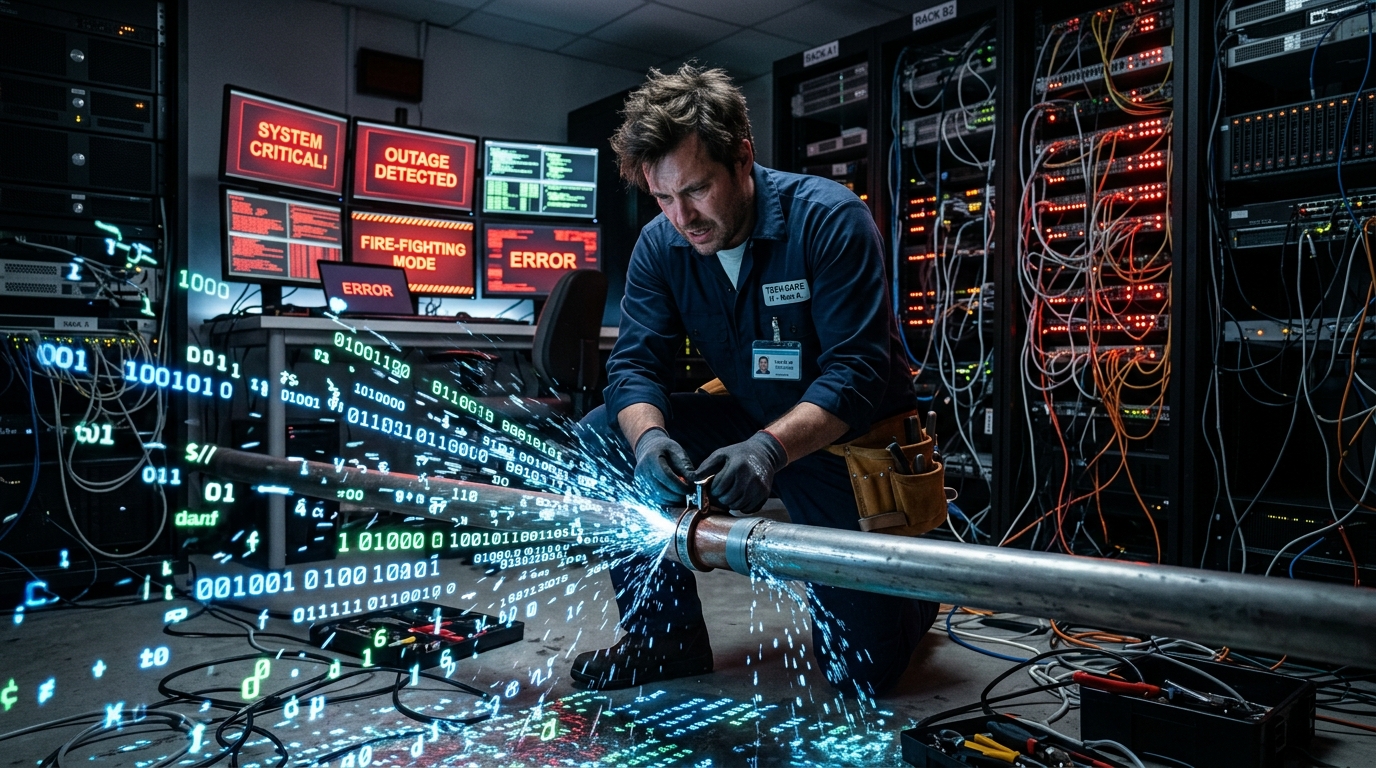
Reactive IT management means fixing problems only after users report them or systems fail. Six signs give it away: users find problems first, the team is always busy but nothing improves, IT status can’t be proven, recovery is untested, key processes depend on one person, and spending is driven by emergencies. Below, we explain each sign and what good looks like.
How TEKNOLOGIIA helps organizations build a more visible, responsive, and resilient IT structure.
Reactive IT rarely begins with a strategic decision. It develops gradually: a temporary workaround becomes permanent, recurring issues consume the team’s time, and urgent requests repeatedly push improvement projects aside. Eventually, IT spends more time responding to problems than strengthening the environment. This is reactive IT management, and it is more common than most organisations expect.
This is usually not a people problem. It is a structural one. As organisations add users, applications, cloud platforms and security requirements, their operating model must evolve too. TEKNOLOGIIA helps businesses make that shift by bringing visibility, clear ownership, continuous monitoring and faster decision-making into day-to-day IT operations.
1. Users discover problems before IT does
When employees are the first to report slow systems, failed services or access issues, the problem often existed long before the ticket was created. Other risks, such as backup failures, certificate expiry, unusual authentication activity or configuration drift, may remain invisible until they cause disruption.
TEKNOLOGIIA combines infrastructure monitoring, managed support and security visibility to identify warning signs earlier, prioritise them and coordinate the right response before they affect operations.
What good looks like: monitoring that raises the alert before the first user does, across endpoints, network, backup and Microsoft 365.
Contact TEKNOLOGIIA to know how monitoring detects and resolves an issue before users or business operations are affected.
2. The team is always busy, but improvement work never moves
A high number of closed tickets may show effort, but it does not always show progress. If recurring incidents keep returning, the support queue consumes the same capacity needed to remove their root causes.
Through Tekno Support and Tekno365, TEKNOLOGIIA helps organisations structure support, analyse recurring issues, document environments and reserve attention for preventive improvements. The goal is not only to close tickets faster, but to reduce how often they occur.
What good looks like: planned and reactive work measured separately, with recurring incidents traced to a root cause and closed permanently.
How to reduce recurring tickets, improve response time, or number of users and endpoints? Ask TEKNOLOGIIA.
Read more about our Decision Intelligence
3 . IT status cannot be demonstrated with confidence
Many organizations have patching, backup, and access-control processes, yet cannot quickly confirm which systems are compliant, which exceptions remain open, and who owns the next action. That gap affects operations, audits, insurance requirements and management decisions.
TEKNOLOGIIA helps establish a current view of the IT environment through asset visibility, patch and configuration oversight, security monitoring, reporting and documented ownership. Exceptions become visible decisions with actions and review dates instead of silent risks.
What good looks like: patch, backup, and access status reported on a fixed schedule, with a named owner and a review date against every open exception.
Ask for our IT Support
4. Backups complete successfully, but recovery is unproven
A successful backup job confirms that data was copied. It does not confirm that the business can resume. Restore duration, application dependencies, credentials and failover behaviour are only proven by testing them, and many organisations discover the gap during an incident rather than before one. In markets where power interruption and single-link connectivity are routine, those assumptions deserve testing rather than trust.
TEKNOLOGIIA helps define recovery objectives, verify backup integrity, schedule restore testing and document the sequence for bringing systems back online. Recovery becomes a measured capability with known timings, rather than an expectation held by a small number of people.
What good looks like: scheduled restore tests and a documented RTO and RPO that have been proven under real conditions.
Explore our IT Support services to see how we help you maintain reliable backups, prepare for disaster recovery, and keep your business running with recovery times you can measure.
5. Essential processes depend on one person
If onboarding, offboarding, access provisioning or recovery depends on one employee’s memory, the organisation carries an operational and security dependency. Delays affect productivity, while incomplete offboarding can leave accounts, permissions and licences active.
TEKNOLOGIIA standardises and documents these workflows, supports Microsoft 365 and identity environments, and helps define responsibilities and escalation paths. Repeatable processes allow the organisation to respond consistently, even when key team members are unavailable.
What good looks like: a documented joiner, mover and leaver process that any qualified engineer can follow to the same result.
Contact TEKNOLOGIIA to augment your Microsoft 365 automation, for example onboarding and offboarding
6. IT spending is driven by emergencies
Unexpected hardware failures, urgent consultancy, last-minute licensing and recovery costs make IT budgets difficult to forecast. When spending is dominated by incidents, long-term improvements are postponed and the reactive cycle continues.
TEKNOLOGIIA brings IT operations under a structured managed-services model with clearer service scope, lifecycle planning and predictable operating costs. This helps leadership distinguish recurring operational needs from strategic projects and prioritise investment with better information.
What good looks like: a defined service scope and a predictable monthly operating cost, with emergency spend as the exception rather than the pattern.
From Reactive IT to Faster and Better Response
A responsive IT structure is built on five foundations: visibility across the environment, clear ownership, defined processes, proven recovery and reliable decision-making. TEKNOLOGIIA connects these foundations through managed IT, cloud and Microsoft services, cybersecurity monitoring, SOC as a Service, MDR, governance support and decision intelligence.
The result is an operating model that detects earlier, responds faster and improves continuously. Internal teams gain the structure and specialist support to focus on business priorities, while leadership receives clearer information about risk, performance and required action.
Build a More Responsive IT Operation
If several of these signs are familiar, the issue is likely structural rather than temporary. TEKNOLOGIIA can assess the current environment, identify the gaps creating repeated disruption and define a practical roadmap toward more proactive, secure and predictable IT operations.
Talk to our experts about improving your IT structure and response readiness.
Frequently Asked Questions – FAQs:
To help you better understand this topic and how it applies to your organization, we have answered some of the most frequently asked questions below:
- What is reactive IT management? Reactive IT management means addressing issues mainly after users report them or systems fail. A more proactive approach uses monitoring, scheduled maintenance, tested backups, and documented processes to reduce disruption.
- How can I tell if my business is managing IT reactively? Look for recurring urgent tickets, problems discovered by users before monitoring alerts, uncertainty about patching, and backups that have never been tested through a restore. Our six signs of reactive IT give you a practical starting point for reviewing your operations.
- How can TEKNOLOGIIA help us move toward managed IT? TEKNOLOGIIA can review your current IT operations, identify gaps in monitoring, patching, recovery, and support processes, and help you build a more predictable way of working. Contact us to discuss where your team is losing time to recurring issues.
- How often should backups be restore-tested? Test restores on a fixed schedule, and test critical systems more often. A successful backup job only proves the data was copied, not that the business can resume.